Pages

Showing posts with label addiction. Show all posts

Tuesday, May 28, 2013

Apotheosis and Popular Culture

The Rotunda
The Apotheosis of Washington
Standing under the massive rotunda of the US Capitol is a pretty awe-inspiring experience. The dome is an architectural masterpiece and national treasure. In the oculus 180 feet overhead is a beautiful fresco painted by Constanino Brumidi entitled The Apotheosis of Washington. It is reminiscent of the frescos we saw in the Sistine Chapel and Vatican Museum and apartments.  I was amazed at the degree to which the painting deified George Washington. Admittedly, Washington was one of those larger-than-life individuals that literally changed the course of history. Few would dispute that the United States of America would even exist were it not for his leadership. But in spite of all he was and did, he was merely a man and these were very high honors. 

But if you check out the definition of apotheosis, then you realize the painting accomplishes exactly what it set out to do. 
Apotheosis: the elevation or exaltation of a person to the rank of a god; deification
In nineteenth century America, George Washington was adored and idealized as a leader. Washington's apotheosis was tolerated and even welcomed by populist thinking. Most would concede this deification was artistic hyperbole and highly metaphorical.  But surprisingly, it was not deemed to be blasphemous--even to a deeply religious populace with puritanical roots.  

I left the Capitol and other Washington monuments with a measure of surprise by the degree to which the nation has deified it's founding fathers (the Washington, Lincoln, Jefferson, Roosevelt memorials to name a few). I was reminded of the cult religions of Imperial Rome, in which Emperors were deified after death to join the panoply of gods. Washington, like Agustus, could transcend mortality and enter the sphere of deity by proclamation of the Senate. 

I really don't have a problem with the honors we pay to these founding fathers. But as a culture we've taken things way too far. After I returned home I overheard two of my staff deeply engrossed with their apotheosis of one of the Kardashians.  The K-A-R-D-A-S-H-I-A-N-S! Just writing the word somehow cheapens this post. Napoleon Bonaparte quipped: "from the sublime to the ridiculous is but a step." If so, then society is taking giant steps like astronauts on the moon in zero gravity. Our apotheosis of celebrities, athletes and even criminals creates a panoply of new deities that consumes our leisure time as we scramble to pay them homage. 

It is interesting to see similar patterns at play in history. Imperial Rome's habit of apotheosis of leaders became a laughing stock, as one inept or corrupt ruler after another was deified and then worshiped. Seneca the Younger, thought that apotheosis had been taken way too far in Rome and didn't view the "new" gods as legitimate. Taking a shot at an old political rival that had banished him, he wrote a political satire* on the apotheosis of Claudius. It was entitled The Apocolocyntosis Divi Claudii (literally The Pumkinification of the Divine Claudius). Seneca and Napoleon were clearly on the same page. 


Our penchants for the apotheosis of everything unholy is a flaw in the fabric of humanity that can be traced back to the earliest times.  It is seen in the idolatry of the Old Testament and the pride of the Book of Mormon. It is wrapped up in the worship of self that so plagues the modern church. I'm as guilty as the next guy, but think that Seneca may be on to a potential antidote. If we could substitute apocolocyntosis for apotheosis on a more regular basis, we may be less inclined to spend our time worshiping stuff that will neither save us or make us happy.
If not apotheosis, then a bad case of obsession

Apocolocyntosis . . . keeping it real

*Apocolocynthosis (gourdification or pumpkinification) is a parody on the word apotheosis

Thursday, January 17, 2013

Addiction: Alypius & The Gladiators (Part 2)


The Christian Martyrs' Last Prayer, 1863
by Jean-Léon Gérôme
Walter Art Museum, Baltimore, MD
The story of Alypius' addiction to gladiatorial games in the waning years of the Roman Empire has me thinking about human susceptibility to addiction in general (here for part 1 of this story).

When I lived in Boston, I was the Home Teacher of a man that became addicted to crack cocaine.  Eddie was not the kind of guy you think of when you say 'crackhead'.  He was smart, sophisticated and wealthy. He lived in a luxury high-rise apartment downtown.  He had worked for years as an auditor for multinational accounting firm. When he found the church he was all in; he was totally passionate about the gospel. On one visit I could tell there had been a significant change in Eddie.  Over the next few months he opened up to me about his problems with drugs. He told me that he tried crack cocaine once, and knew immediately that he was hopelessly addicted (I remember feeling the same way the first time I caught a trout on a dry fly). His love for God and the gospel took a back seat. I watched on rather helplessly as he gradually withered. Though I tried to keep in touch after I moved to Nevada, he wasn't interested. Ultimately he died angry and bitter. 

You cannot become addicted to cocaine without trying it first; you can't become a slave of the Colosseum without going to watch the games. Alypius' problems didn't begin with a decision to go see Christians be covered in pitch, crucified and then set ablaze, or sewn into animal hides and left to be torn to pieces by starving lions. Eddie's fight to the death with cocaine began when he threw caution to the wind and allowed another addict to talk him into buying the drugs they could then share. What Eddie and Alypius had in common on day one of their individual battles with addiction was an arrogance that made them feel invulnerable to something they knew was wrong. 


Augustine said that Alipius' soul "was more audacious than truly valiant--also it was weaker because it presumed on its own strength when it ought to have depended on Thee." The line that separates being valiant from being audacious is sometimes pretty thin.  To be valiant is to show courage, determination and excellence.  Audaciousness is a willingness to take bold risks, usually while showing impudent lack of respect to custom or prevailing wisdom. Alypius confidently proclaimed: “Though you drag my body to that place and set me down there, you cannot force me to give my mind or lend my eyes to these shows. Thus I will be absent while present, and so overcome both you and them.”  But this valiant exterior was just the facade of an audacious young man that had too much confidence in himself, and too little respect for Satan.

If audaciousness and excessive self-confidence sets the stage for our addictions, then it is supplemented by forgetting the we aren't supposed to face these challenges alone:
[The Lord] knows the mistakes we can so easily make: to underestimate the forces working for us and to rely too much on our human powers. And so He offers us the covenant to "always remember Him" and the warning to "pray always" so that we will place our reliance on Him, our only safety. Elder Henry B. Eyring, Always, CES Fireside (Oct Ensign 1999)
In Augstine's account of the addiction of Alypius, he also highlighted the way of out the nightmare in which Alypius was trapped. It seems that Augustine scooped every 12-step program ever published by pointing out that the Lord rescued Alypius and taught him "not to rest his confidence in himself but in thee". As he did so, Alypius walked away from one master into the arms of Another.


Friday, January 11, 2013

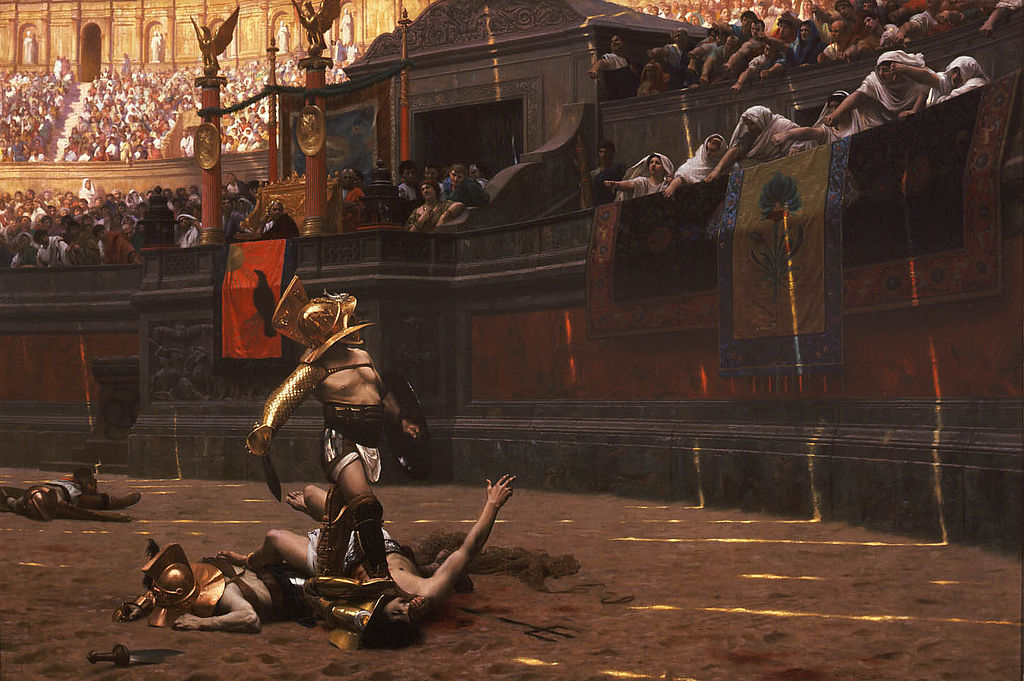
Addiction: Alypius & The Gladiators


Pollice Verso (Thumbs Down), 1872  
by Jean-Léon Gérôme (Phoenix Art Museum)
Alypius* was a life-long friend of Augustine of Hippo, one of the greatest Christian thinkers of all time. Both were born in the 4th century in Numidia (current Algeria) which was part of Roman North Africa.  They were converted to Christianity together while studying in Milan. Though revered as a Saint of the Catholic Church, there was a time in his life when Alypius seemed hopelessly enslaved to an addiction of the most unlikely sort.  Augustine describes the plight of his friend better than I could ever hope to.
 "He had gone on to Rome before me to study law . . . and there he was carried away again with an incredible passion for the gladiatorial shows. For, although he had been utterly opposed to such spectacles and detested them, one day he met by chance a company of his acquaintances and fellow students returning from dinner; and, with a friendly violence, they drew him, resisting and objecting vehemently, into the amphitheater, on a day of those cruel and murderous shows. He protested to them: “Though you drag my body to that place and set me down there, you cannot force me to give my mind or lend my eyes to these shows. Thus I will be absent while present, and so overcome both you and them.” When they heard this, they dragged him on in, probably interested to see whether he could do as he said. When they got to the arena, and had taken what seats they could get, the whole place became a tumult of inhuman frenzy. But Alypius kept his eyes closed and forbade his mind to roam abroad after such wickedness. Would that he had shut his ears also! For when one of the combatants fell in the fight, a mighty cry from the whole audience stirred him so strongly that, overcome by curiosity and still prepared (as he thought) to despise and rise superior to it no matter what it was, he opened his eyes and was struck with a deeper wound in his soul than the victim whom he desired to see had been in his body. Thus he fell more miserably than the one whose fall had raised that mighty clamor which had entered through his ears and unlocked his eyes to make way for the wounding and beating down of his soul, which was more audacious than truly valiant--also it was weaker because it presumed on its own strength when it ought to have depended on Thee. For, as soon as he saw the blood, he drank in with it a savage temper, and he did not turn away, but fixed his eyes on the bloody pastime, unwittingly drinking in the madness--delighted with the wicked contest and drunk with blood lust. He was now no longer the same man who came in, but was one of the mob he came into, a true companion of those who had brought him thither. Why need I say more? He looked, he shouted, he was excited, and he took away with him the madness that would stimulate him to come again: not only with those who first enticed him, but even without them; indeed, dragging in others besides. And yet from all this, with a most powerful and most merciful hand, thou didst pluck him and taught him not to rest his confidence in himself but in thee--but not till long after."  Augustine - Confessions VI;8:13
Addiction is "the state of being enslaved to a habit or practice or something that is psychologically or physically habit-forming to such an extent that cessation causes severe trauma". Though the allure of watching slaves and criminals battle to the death is hardly on our top ten list of addictions to watch out for, the story of Alypius illustrates how susceptible the human brain is to addiction. A review of the diagnostic criteria for addiction (here) makes it pretty clear that its not just nicotine, alcohol or drugs that have addictive potential (here for a look at modern addictions). Most of us wouldn't think of work, shopping, Facebook, texting, or video games as being much more of an addictive threat than gladiatorial games. But this lack of respect is disarming and very dangerous. In reality, addiction is so multifaceted that it holds the potential to threaten most of us. Addiction is a lot like eBay--there's something for everyone. 

Parallels between the story of Alypius and the modern plague of pornography should be obvious  (GBH's watershed talk here; Dallin H. Oaks here). One look was all it took for Alypius to be drawn in. Spurred on with curiosity "he opened his eyes and was struck with a [deep] wound in his soul" that took him years to recover from. The exact words could be used to describe those ensnared by pornography.

In his Conference talk on addiction a few years ago, M. Russel Ballard described addiction as surrender. He said "any kind of addiction is to surrender to something, thus relinquishing agency and becoming dependent". Surrender to anything other than God is tantamount to idolatry. It is a moment Satan instantly recognizes; he will immediately move in to seize control. Elder Ballard went on to teach that the cause of the disease and its remedy are different faces of the same coin: 
"Ask him for the strength to overcome the addiction you are experiencing. Set aside all pride and turn your life and heart to Him." 
As we surrender to our addiction we are enslaved by it. On the other hand, as we surrender to God we are liberated by Him.  


__________

* He is also referred to as Saint Alypius of Thasgate