Pages

Showing posts with label agency. Show all posts

Sunday, January 12, 2014

The Predator Crouching at Your Door


Cain and Abel - Titian
oil on canvas, 1542-1544
Santa Maria della Salute, Venice
The seemingly arbitrary rejection of Cain’s offering and acceptance of his brother Abel’s offering outlined in Genesis 4 has long been a source of contention for non-believers.  They say this passage speaks of a capricious God that is unpredictable and vindictive. 

Yet though we readily recognize the Messianic symbolism of Abel’s offering, the Mosaic law did allow for bloodless offerings. It was more the attitude that accompanied Cain's offering, than the nature of the offering, which made it unacceptable.  This is taught with greater clarity in the Pearl of Great Price than in any translation of the Bible or it’s accompanying commentaries. 
And Cain loved Satan more than God. And Satan commanded him, saying: Make an offering unto the Lord. And in the process of time it came to pass that Cain brought of the fruit of the ground an offering unto the Lord. And Abel, he also brought of the firstlings of his flock, and the fat thereof. And the Lord had respect unto Abel, and to his offering; But unto Cain, and to his offering, he had not respect. Now Satan knew this, and it pleased him. And Cain was very wroth, and his countenance fell. (Moses 5:18-21)
It is argued that Cain had a bad attitude from the start, but when he (and to a lesser extent, his offering) was rejected, he lost it completely.  To say he ‘was very wroth’ in our vernacular is understatement. One commentary translates this phrase literally as “it burned with Cain exceedingly”. 

The account in Genesis describes things rapidly going downhill from this point. But before that point of no return, there was a moment when God reached out to Cain.  I found it helpful to consider other biblical translations of Genesis 4:7 which describes this moment.

KJV
If thou doest well, shalt thou not be accepted? and if thou doest not well, sin lieth at the door. And unto thee shall be his desire, and thou shalt rule over him.
NKJV
“If you do well, will you not be accepted? And if you do not do well, sin lies at the door. And its desire is for you, but you should rule over it.”
ESV
If you do well, will you not be accepted?fn And if you do not do well, sin is crouching at the door. Its desire is for you, but you must rule over it.”
NIV
If you do what is right, will you not be accepted? But if you do not do what is right, sin is crouching at your door; it desires to have you, but you must rule over it.”

The metaphor of sin crouching at the door, like an unseen predator that would devour him, is incredibly powerful.  Perhaps it was meant to foreshadow the role Cain would play in the destruction of his brother. In this regard, the ESV and NIV are particularly useful. But even in his outreach, God respects the agency of Cain.

But once again, the Pearl of Great Price is critical in understanding the process by which we make ourselves (and our offerings) acceptable to God. 
If thou doest well, thou shalt be accepted. And if thou doest not well, sin lieth at the door, and Satan desireth to have thee; and except though shalt hearken unto my commandments, I will deliver thee up, and it shall be unto thee according to his desire. And thou shalt rule over him;   (Moses 5:23)
Ultimately, Cain 'rejected the greater counsel which was held of God’ (Moses 5:25) and remained ‘wroth, and listened not anymore to the voice of the Lord’ (Moses 5:26). This was no crime of passion, but rather obstinate rejection of the outreached hand of the Lord, preferring instead to ‘glory in his wickedness’ (Moses 5:31in the company of Satan. It is the first recorded Faustian pact in history. Cain didn’t become Perdition by falling victim to some unseen predator lurking in the doorway. He chose it. 

Although Cain’s fall was foreseeable, it was still preventable: do well and be accepted, otherwise sin lies at the door.


Saturday, June 8, 2013

The Sons of Perdition and the Gates of Hell

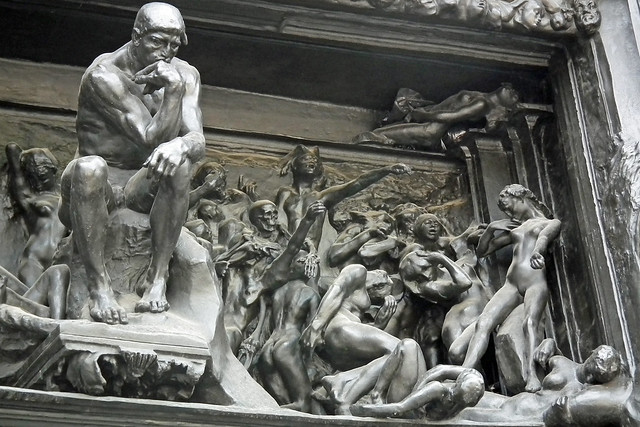
La Porte de l'Enfer (The Gates of Hell)
Auguste Rodin

Detail from The Gates of Hell


I guess you could say I visited the gates of hell and lived to tell about it. When I was in Philadelphia last year I made a visit to the Rodin Museum where I saw La Porte de l'Enfer (The Gates of Hell). Thankfully, the number of mortals that will actually visit the literal gates of hell* are extremely few.  In fact, the club is so exclusive, that we will probably live out our lives and never meet a member of it.  But while reading D&C 76, I was impressed with the details describing the fate of those souls banished to eternal hell:

32 They are they who are the sons of perdition, of whom I say that it had been better for them never to have been born

33 For they are vessels of wrath, doomed to suffer the wrath of God, with the devil and his angels in eternity

34 Concerning whom I have said there is no forgiveness in this world nor in the world to come— 

35 Having denied the Holy Spirit after having received it, and having denied the Only Begotten Son of the Father, having crucified him unto themselves and put him to an open shame. 

36 These are they who shall go away into the lake of fire and brimstone, with the devil and his angels— 

37 And the only ones on whom the second death shall have any power; (D&C 76:32-37; emphasis mine)

For the Lord to say it is better that they had never been born is saying something. Birth and mortality are part of his great plan to bless his children and crown them with glory (see the rest of section 76 for this). Therefore suffering the wrath of God for eternity is very much out of keeping with his nature. But agency is such a central part of God's plan that he is bound to honor it. For the sons of perdition, their recalcitrant refusal to be saved—even in the face of irrefutable evidence of God's power and grace to redeem them—is respected.

CS Lewis is my favorite Christan apologist. He had quite a lot to say on the subject (here for a good summary). 

“I willingly believe that the damned are, in one sense, successful, rebels to the end; that the doors of hell are locked on the inside.”   – The Problem of Pain


"A man can't be taken to hell, or sent to hell: you can only get thee on your own stream."    – The Dark Tower

“There are only two kinds of people in the end: those who say to God, ‘Thy will be done,’ and those to whom God says, in the end, ‘Thy will be done.’ All that are in Hell, choose it. Without that self-choice there could be no Hell. No soul that seriously and constantly desires joy will ever miss it. Those who seek find. To those who knock it is opened.”    – The Great Divorce

“A damned soul is nearly nothing: it is shrunk, shut up in itself. Good beats upon the damned incessantly as sound waves beat on the ears of the deaf, but they cannot receive it. Their fists are clenched, their teeth are clenched, their eyes fast shut. First they will not, in the end they cannot, open their hands for gifts, or their mouths for food, or their eyes to see.”  – The Great Divorce

If the sons of perdition are the only ones that will not be redeemed in the due time of the Lord, it follows that everyone else will be. All but the sons of perdition will eventually receive forgiveness. Hopefully we apply the atonement and realize that forgiveness it in this world rather than in the world to come. But either way, the Lord intends to redeem the works of his creation (D&C 76:43).

For all the rest shall be brought forth by the resurrection of the dead, through the triumph and the glory of the Lamb, who was slain, who was in the bosom of the Father before the worlds were made.   D&C 76:39

There is a difference between inheriting the kingdom of heaven and inheriting glory.  Though exaltation in the celestial kingdom is a lofty goal (see Matthew 7:13-14; D&C 76:109), it is well within our reach (see Alma 7:14).  For those that fail to seize it, the consolation prize is not too shabby:

The Lord thy God in the midst of thee is mighty; he will save, he will rejoice over thee with joy; he will rest in his love, he will joy over thee with singing. Zephaniah 3:17

_____

* I'm referring to the gates of hell that lead to the lake of fire reserved for the devil, his angels and the sons of perdition, not the temporary hell where captive spirits suffer for their sins prior to resurrection (here for a good overview).

Sunday, November 4, 2012

Limits To The Power of the Lord

'Head of Christ'
oil on oak, circa 1648-1650

Staatliche Museen zu Berlin
by Rembrandt Harmenszoon van Rijn

There's nothing like an election year to bring out the worst in people. As the rhetoric heats up, it's no longer just the candidates that are vilified, but their supporters as well. Republicans are painted as heartless capitalists and religious fanatics that are all racist to the core. Democrats are portrayed as godless sluggards in perpetual search for government handouts--able but unwilling to take responsibility for themselves. Truth falls victim to 'the greater good' as it is conceived by special interest groups that fund the parties. 

These days my political passions run strong because I believe the future of this country is on the line. There have been many days when I've wondered if one person/one vote makes any sense. After all, about half of the people are going to get it wrong on election day. It's easy to feel frustrated and powerless, especially when the choice before us seems so obvious. 

As I work through my temptation to 'destroy the agency of man' this election year, I've spent some time thinking about the seriousness with with God views agency and free will. We're accustomed to thinking of the limitless power of God and take great courage in being aligned with him. Yet how often do the scriptures describe him lamenting because what he could not do? "O Jerusalem, Jerusalem, which killest the prophets, and stonest them that are sent unto thee; how often would I have gathered thy children together, as a hen doth gather her brood under her wings, and ye would not!" (Luke 13:34; see also  Chiasmus in 3 Nephi 10).

The Savior undoubtedly experienced great frustration during his earthly ministry (here for a take on Rembrandt's portrayal of the face of Jesus). Though all powerful, he was rendered powerless by the agency of others. 
Is not this the carpenter, the son of Mary, the brother of James, and Joses, and of Juda, and Simon?  and are not his sisters here with us? And they were offended at him.  But Jesus said unto them, A prophet is not without honor, but in his own country, and among his own kind, and in his own house. And he could there do no mighty work, save that he laid his hands upon a few sick folk, and healed them. And he marvelled because of their unbelief. An he went round about the villages, teaching. Mark 6:3-6 (emphasis mine)
Amulek taught that Christ cannot save us in our sins.  Imagine a Savior that cannot save!
And I say unto you again that he cannot save them in their sins; for I cannot deny his word, and he hath said that no unclean thing can inherit the kingdom of heaven; therefore, how can ye be saved, except ye inherit the kingdom of heaven? Therefore, ye cannot be saved in your sins. Alma 11:37 (emphasis mine; see also verses 40-41)
'Head of Christ'
oil on oak, circa 1648-1656

Philadelphia Museum of Art
by Rembrandt Harmenszoon van Rijn
Though Satan still attempts to frustrate the works of God, it is the god-given agency that Satan tried to destroy that limits God's power. Ironic!  It was determined faithlessness--enabled by agency--that allowed the miracles of the Savior to fall ineffectually to the soil in Nazareth.  It is the desperate clinging to sin--enabled by agency--that allows men to stand before a Savior that cannot save them.

It would seem that even God sees limits to his power, through his own promise to respect the agency of men. No doubt he feels frustration on a level that we can't dream of--even in an election year. Perhaps we should take time to reverence the principle of agency, whether is that of a political rival, or someone that chooses to live and believe in something different than we do.

Had he wanted, the Lord could have forced the miracle in Nazareth or saved the sinner by compelling them to repent.  He chose not to, out of reverence for the agency of man. I guess I would be wise to do the same, and carry on (the Savior didn't quit after the whole Nazareth debacle). Some things are not ours to control.
'Head of Christ'
oil on oak, circa 1648-1654
Detroit Institue of Art
by Rembrandt Harmenszoon van Rijn

During these times of distress and frustration, we must not forget that, though respectful of our agency, the Lord remains all-knowing, and all powerful. He has answers to all our problems and promises peace to those that seek him. 
Cry unto him for mercy, for he is mighty to save.  (Alma 34:18; see also 2 Nephi 31:39 and D&C 133:47).
Sometimes, in the press right before an election (or the powerlessness of everyday life), that is all we can do.