Pages

Showing posts with label pride. Show all posts

Friday, March 21, 2014

Titanism

Illustration from Dante's Divine Comedy
by Gustave Gore
First Published March 20, 2014 at Modern Mormon Men

In the October 1964 General Conference, Sterling W. Sill made this bold assertion:
"Certainly the greatest problem of our generation is its titanism, as shown by our enmity toward the Almighty."
I have to admit that I had never heard of titanism prior to reading his talk (which immediately made it into my General Conference Classics file). In classical Greek mythology, the Titans were a race of giants with enormous size and strength that sought to rule heaven. They made war with Zeus and the other Olympians, but were ultimately defeated and thrown down. Titanism has therefore come to represent the tendency to be at defiance and revolt against tradition, convention and established order. Elder Still used titanism to represent "our unfortunate human inclination to fight against righteousness ... [and wage] war against God and his purposes."

The parallels between the War of the Titans and the War in Heaven (Revelation 12:3-14) are hard to miss. Similarly, we can't make it through an entire day without being confronted by the ferocity with which the world takes the fight to the gates of Heaven. But Elder Still wasn't talking to the world as much as he was talking to the church. The Church has always known it's share of conflict from within; perhaps the most unlikely titans that battle God do so from within His Church.

With the Priesthood Session of General Conference just around the corner, battle lines seem to be forming once more. The Ordain Women movement seems determined to press it's case, and the Church equally determined to hold the line. Not only was their petition for tickets denied, but their premise was labelled as "contrary to revealed doctrine". They were asked not to protest, but given maps on how to find "free speech zones" if they insist on doing so.

Let me be clear that I am not redefining titanism as the OW movement or any other movement in the Church. Any attempt to compile a list of offenses constituting titanism would be presumptuous; it's manifestations are highly individual anyways. Fundamentally, titanism is a state of mind that puts us at war with God on a individual level: our priorities become more important than God's priorities. Though we may agree with Him on everything else, even one point of disagreement is enough--if we feel strongly enough about it.

Though his talk was given almost 50 years ago, Elder Still's words resonate surprisingly well for us today (shades of President Benson's Beware of Pride). As a result we may immediately think he was focused on [insert the vocal iconoclast you find yourself most at odds with here]. But after reading this talk I had my own Robert De Niro-talking-to-himself-in-the-mirror moment. I realized that he is talking  to me. The rest of you might want to listen up as well. His words are not just descriptive of what ails us today, they also offer specifics on how to cure it:
"The greatest miracle ever performed by Jesus was not in controlling the angry sea but in disciplining his own will ... What a tremendous benefit we could bestow upon ourselves by calling off the war and learning to live at peace with God, not only in obeying him but also in agreeing with him."
God's requirement that we surrender our will to His, is asking a lot.  C. S. Lewis and Neal A. Maxwell have both weighed in on this with their usual eloquence.  But though the Lord asks everything of us, He has promised us much in exchange.
Behold, the Lord requireth the heart and a willing mind; and the willing and obedient shall eat the good of the land of Zion in these last days. (D&C 64:34)
Periodically we all find ourselves in defiance with God. Though we may find ourselves surrounded by many like-minded souls, ultimately it's how much we share in common with God the matters most. One of the first steps in creating a lasting peace with God is deciding to "lay down the weapons of [our] rebellion" (Alma 23:7) and surrender to God. It is not sufficient to just walk away like some Zerahemnah. The gesture must be accompanied with a willing mind and followed by humble obedience. This may take a while.

Thursday, January 17, 2013

Addiction: Alypius & The Gladiators (Part 2)


The Christian Martyrs' Last Prayer, 1863
by Jean-Léon Gérôme
Walter Art Museum, Baltimore, MD
The story of Alypius' addiction to gladiatorial games in the waning years of the Roman Empire has me thinking about human susceptibility to addiction in general (here for part 1 of this story).

When I lived in Boston, I was the Home Teacher of a man that became addicted to crack cocaine.  Eddie was not the kind of guy you think of when you say 'crackhead'.  He was smart, sophisticated and wealthy. He lived in a luxury high-rise apartment downtown.  He had worked for years as an auditor for multinational accounting firm. When he found the church he was all in; he was totally passionate about the gospel. On one visit I could tell there had been a significant change in Eddie.  Over the next few months he opened up to me about his problems with drugs. He told me that he tried crack cocaine once, and knew immediately that he was hopelessly addicted (I remember feeling the same way the first time I caught a trout on a dry fly). His love for God and the gospel took a back seat. I watched on rather helplessly as he gradually withered. Though I tried to keep in touch after I moved to Nevada, he wasn't interested. Ultimately he died angry and bitter. 

You cannot become addicted to cocaine without trying it first; you can't become a slave of the Colosseum without going to watch the games. Alypius' problems didn't begin with a decision to go see Christians be covered in pitch, crucified and then set ablaze, or sewn into animal hides and left to be torn to pieces by starving lions. Eddie's fight to the death with cocaine began when he threw caution to the wind and allowed another addict to talk him into buying the drugs they could then share. What Eddie and Alypius had in common on day one of their individual battles with addiction was an arrogance that made them feel invulnerable to something they knew was wrong. 


Augustine said that Alipius' soul "was more audacious than truly valiant--also it was weaker because it presumed on its own strength when it ought to have depended on Thee." The line that separates being valiant from being audacious is sometimes pretty thin.  To be valiant is to show courage, determination and excellence.  Audaciousness is a willingness to take bold risks, usually while showing impudent lack of respect to custom or prevailing wisdom. Alypius confidently proclaimed: “Though you drag my body to that place and set me down there, you cannot force me to give my mind or lend my eyes to these shows. Thus I will be absent while present, and so overcome both you and them.”  But this valiant exterior was just the facade of an audacious young man that had too much confidence in himself, and too little respect for Satan.

If audaciousness and excessive self-confidence sets the stage for our addictions, then it is supplemented by forgetting the we aren't supposed to face these challenges alone:
[The Lord] knows the mistakes we can so easily make: to underestimate the forces working for us and to rely too much on our human powers. And so He offers us the covenant to "always remember Him" and the warning to "pray always" so that we will place our reliance on Him, our only safety. Elder Henry B. Eyring, Always, CES Fireside (Oct Ensign 1999)
In Augstine's account of the addiction of Alypius, he also highlighted the way of out the nightmare in which Alypius was trapped. It seems that Augustine scooped every 12-step program ever published by pointing out that the Lord rescued Alypius and taught him "not to rest his confidence in himself but in thee". As he did so, Alypius walked away from one master into the arms of Another.


Sunday, January 6, 2013

Stealing Thunder

The other day, Tate was looking at treasures in my den and came upon this rare find. The beautiful patina indicates it comes from a bygone era; it's safe to say there are only a handful in existence. Recognizing a genuine antiquity when he saw it, he immediately asked the golden question: "Can I have this when you die?" 

Now that kind of question could easily precipitate a full-blown panic attack in any other middle-aged Mormon male.  The quiet little voice inside your head suddenly starts shouting: My kids are already jockeying for position for when they read my will! Do I really look that out of shape? But not so for me. Tate has been asking the golden question for years. (We chalk it up to a racer's instinct for the advantage of the inside line . . . plus it never hurts to ask). 


My 'Major Award'
That's right folks, it was evident from a very early age that something special was going on here. It was so apparent that someone had my name engraved on a trophy! I even remember the Bishop shaking my hand and recognizing me in front of the whole congregation at church on Sunday.  The covetous look in my son's eyes as he held my 'major award' brought these memories rushing back to me in an instant. I took the trophy and was about to launch into an extended monologue of self-adoration when I noticed the dates on the plaque: 1967-68.


My gloating quickly ended. I turned 4 in 1968, which means I was a SUNBEAM. It is quite probable that I couldn't even tie my own shoes, let alone do anything to ensure that I had perfect Primary attendance. What first appeared a recognition of my precociousness was in reality a monument to my mother. Though she's been gone for many years, I feel like she's still cheering me on. What a mother I have. Were the truth fully known, we could probably erase our names from the 'major awards' in our lives and instead inscribe 'presented to Reid Litchfield on behalf of his mother'.*  Thanks mom. Sorry I almost stole your thunder.
______

* I think after 25-30 years we could arguably substitute 'wife' for 'mother' on the trophy.  

Friday, November 9, 2012

Getting Chosen

Scene from the 1993 classic: The Sandlot
Anyone from my era has recollections of the anxiety provoked by the Physical Education teacher telling us to "line up and pick teams".  I'm not sure if they still do this given how traumatic it can be for the kid picked last. I vividly recall the anticipated horror of being unchosen, and forced upon the team with the last pick. Kids generally were not that nice about those kinds of things. It was a cold reminder of social stature on the playground and left the unchosen one feeling unwanted, rejected and less valuable than everyone else (see a related diatribe here). Thankfully, if it happened to me, I've managed to repress the memory.  Still, there was always one unfortunate kid at every game. For those unchosen, it was a big deal--not always something you could just walk off. In contrast, the prospects of always being chosen and highly valued didn't just impact playground hierarchy, it also influenced one's self-esteem.  

These playground memories came back to me as I was reading about what it means to be chosen from the perspective of scripture.  In the scriptures, the theme of being chosen first by God is remarkably pervasive.  It is beautifully summarized in Deuteronomy:  
For thou are an holy people unto the Lord thy God: the Lord thy God hath chosen thee to be a special people unto himself, above all people that are upon the face of the earth. Deuteronomy 7:6 (see also Deuteronomy 14:2)
The scriptures have some pretty high-profile passages that refer to the elite status of the chosen: "many are called but few are chosen" (D&C 121:34, 40; see also Matthew 20:16; Matthew 22:14; Abraham 3:23) is often our mantra in the church. We are also promised that, because of this chosen status, we will be highly favored, blessed and sanctified by God (D&C 19:9; D&C 95:8; D&C 105:35-36). If being chosen first on the playground boosts our sense of worth and confidence, then being chosen first by God should be of enormous advantage in life. 

Yet, like the children of Israel, we are extremely vulnerable to a certain elitism that comes from being one of the chosen.  We must ever remember that the line between self-worth and pride is razor thin. To cross it is to lose any advantage we had from being picked first. As I think about the "many are called but few are chosen" mantra, I realize that things could just as easily have been stated thus: 
Though many are called, most remain unchosen.*
It should be enough to bring back the awful sense of foreboding you felt as a kid in PE. "What if I don't get picked!" 

The unchosen in PE would have done almost anything to be chosen. Yet there was only so much a kid could do: it all boiled down to a complex mix of popularity and athletic ability. But the same is not true of those that would be picked first by the Lord.  In fact, it has nothing to do with popularity, ability or lineage.  Rather, it is all about believing in Christ:
Father, I thank thee that thou hast given the Holy Ghost unto these whom I have chosen; and it is because of their belief in me that I have chosen them out of the world3 Nephi 19:20 (emphasis mine; see also 3 Nephi 19:28)
It remains within our own control whether we are chosen or unchosen.  Independent of our assets or popularity, we can be on the team. And, once there, it is within our ability perform at a level that vastly exceeds our talents.
But God hath chosen the foolish things of the world to confound the wise; and God hath chosen the weak things of the world to confound the things which are mighty. 1 Corinthians 1:27
_____________

* But behold, verily I say unto you, that there are many who have been ordained among you, whom I have called but few of them are chosen. They were are not chosen have sinned a very grievous isn, in that they are walking in darkness at noon-day. D&C 95:5-6.

Saturday, August 25, 2012

The Spirit of Diotrephes & Preeminence


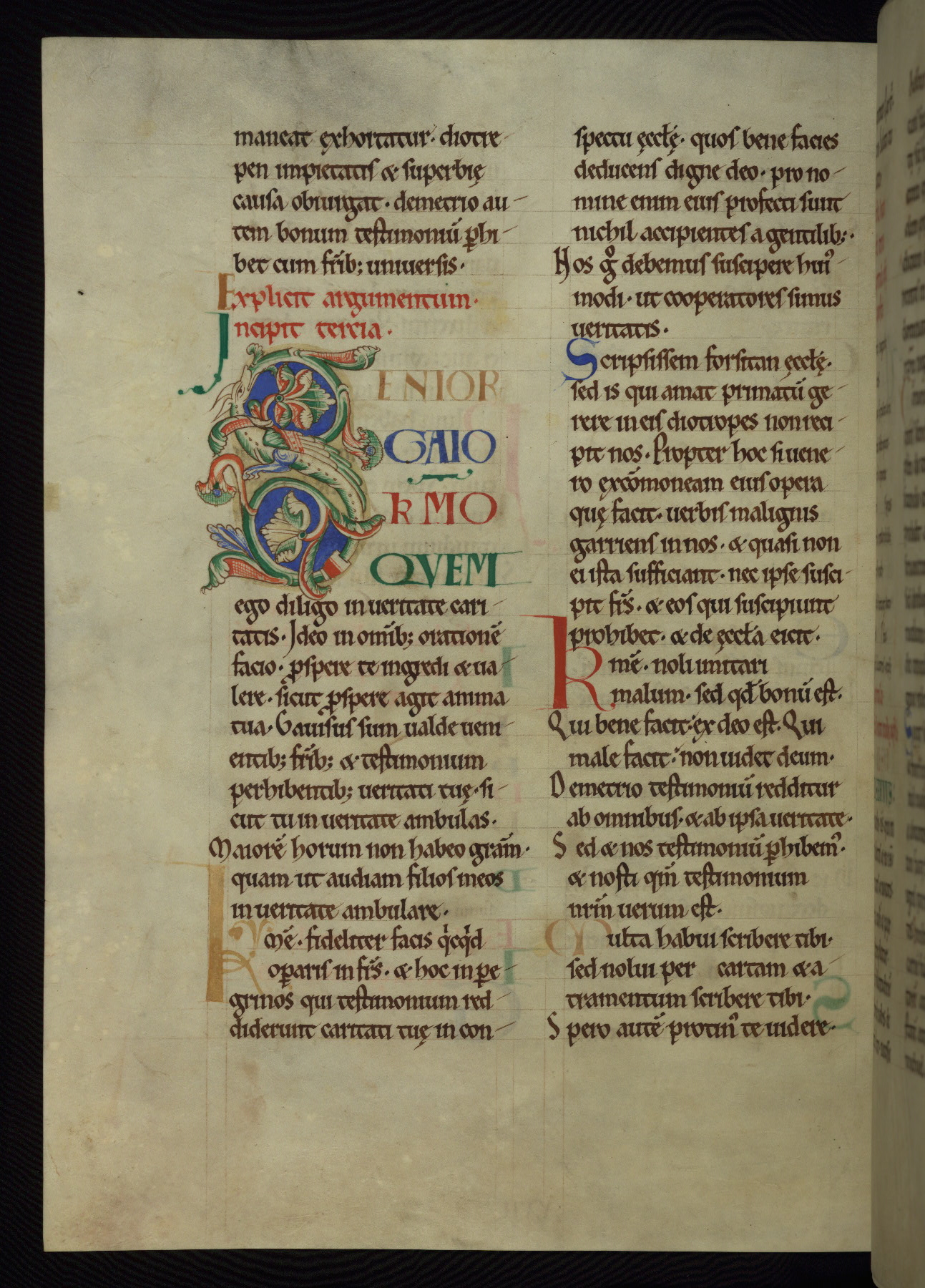
A sinuous dragon disgorging a leafy, flowering stalk, itstail terminating in another leafy vine, forms this letter "S" on the titlepage of the Third Epistle of St. John the Apostle.

Preeminence is one of those superlatives to which we can only hope to aspire.  A word with universally positive connotations: distinction, excellence, prominence, renown, superiority, supremacy, transcendence. If someone or something is preeminent ina group, they are more important, powerful, or capable than other people orthings in the group.

The word preeminence occurs only twice in the KJV of the New Testament. In Colossians 1:18, Paul uses the word proteuo [G4409- translated as preeminence in KJV, means to be first or foremost] to describe Jesus Christ.[1]  If ever one can be called preeminent, it is the Savior.  The word preeminence also appears in John's third epistle as he publicly castigates a shadowy person named Diotrephes: 3 John 1:9.  In this case preeminence stems from philoproteuo [G5383], which literally means love of being first (philo = love; proteuo = being first). 

I find brief scriptural references to otherwise unknown people fascinating (see my posts on Demas here and here). We know almost nothing about Diotrephes, since his name only appears in this passage.  For me, the ESV translation of this  passage gives clearer insight into who Diotrephes was and what he was like. 

I have written something to the church, but Diotrephes, who likes to put himself first, does not acknowledge our authority. 
10 So if I come, I will bring up what he is doing, talking wicked nonsense against us. And not content with that, he refuses to welcome the brothers, and also stops those who want to and puts them out of the church. 
3 John 1:9-10 (ESV)

 Somewhat ironically, his name means 'nourished by Jove'; if you were a superstitious Roman you might think this could lead to preeminence.[2]  But it was not legitimate preeminence that led John to publicly call out Diotrephes. It was Diotrephes' desire to put himself first that brought out John's ire.[3] This desire crippled his ability to acknowledge the authority of one of the Twelve. It suggests he was unwilling to defer to the priesthood leadership of the church. He was certainly prone to backbiting and trash-talking about the the church leaders. Finally, it seems that he was bent on driving out those people that he didn't like. 

Unfortunately, the Spirit of Diotrephes is alive and well; it is manifest in those that cannot (or will not) submit to the authority of God's earthly (albeit imperfect) representatives.  It is heard in the hypercritical appraisals of (admittedly imperfect) women and men that are serving in the church.  It is seen in the attempt to create a church that is so homogenous that there simply is not room for those that don't fit the mold.  

In a word, the character flaws of Diotrephes can be summarized as pride. It is the sin of putting our will, needs, agenda and self-love ahead of God. Ezra Taft Benson called it the universal sin: it's not just the other guy's problem.  

Diotrephes joins a long list of saints that have become defined for their failings.  Whether he got it together or continued to buck the system, we'll have to wait and see.  It seems pretty clear that individually we need to get it together--the sooner the better--and root out the Spirit of Diotrephes from our lives.


[1] In Romans 3:1,Paul uses a related word to describe the lack of preeminence [G4053- perissos] of the Law of Moses, compared to the Law of Christ.
[2] Jovewas the supreme god of the Romans. 
[3]  Itypically associate John 'the beloved' with some of the greatest writings inscripture on love.  But in his third epistle, he was very annoyed and itcomes through loud and clear.


Tuesday, August 7, 2012

Rameumpti


For the Zoramites, the Rameuptom was all about indulging their pride. Yet everything was tidily packaged into something much more socially acceptable: worship. It is SO much easier to rationalize when couched in these terms. 


While teaching Sunday School recently, we spent a few minutes talking about the Rameumptom. Paul Riddle leaned over to Tate and indiscreetly pointed out that my Rameumptom was my new bike. It was pretty funny, and spot on. All I could say was Touche´.[1]

It's sobering to realize the degree to which we become experts in justifying the Rameumpti in our lives.  In this case, words like  fitness, performance, craftsmanship, passion all worked very well.[2] I guess there are some Zoramite tendencies (aka pride) in me that I need to still work on. Even more remarkable is my ability to instantly recognize the Rameumpti of others, even while perched atop one of my own that is so easily justifiable in my own mind. 

This is going to take some time . . . 


[1] In this case 3-4 times a week for at least and hour instead of a few moments on Sunday.
[2] I could go on at length about why I NEEDED the new French road bike with Italian components and tubular wheels.