Pages

Showing posts with label Book of Mormon. Show all posts

Wednesday, October 3, 2012

Mormon's 'Great and Terrible' Leitmotif in 3 Nephi 8

Leitmotif associated with Siegfried
from Richard Wagner's opera Siegfried - The Ring of the Nibelung
The concept of a leitmotif is a musical or literary theme that becomes associated with a particular person, place or  idea in a larger work.  Wagner is one of the earliest classical composers that used this.  Perhaps the best contemporary examples are John Williams' use of leitmotif in Star Wars (here for a great example).

The Book of Mormon holds many examples of literary leitmotif. In the case of 3 Nephi 8, Mormon uses 'great and terrible' (or sometimes these words individually) as a leitmotif throughout the chapter:
  • great doubtings and disputations (verse 4)
  • great storm (verse 5)
  • great and terrible tempest (verse 6)
  • terrible thunder (verse 6)
  • great and terrible destruction in the land southward (verse 11)
  • more great and terrible destruction in the land northward (verse 12)
  • exceedingly great quaking of the whole earth (verse 12)
  • great mourning and howling and weeping among all the people (verse 23)
  • great were the groanings of the people (verse 23)
  • darkness and the great destruction which had come upon them (verse 23)
  • 'O that we had repented before this great and terrible day' (verse 24)

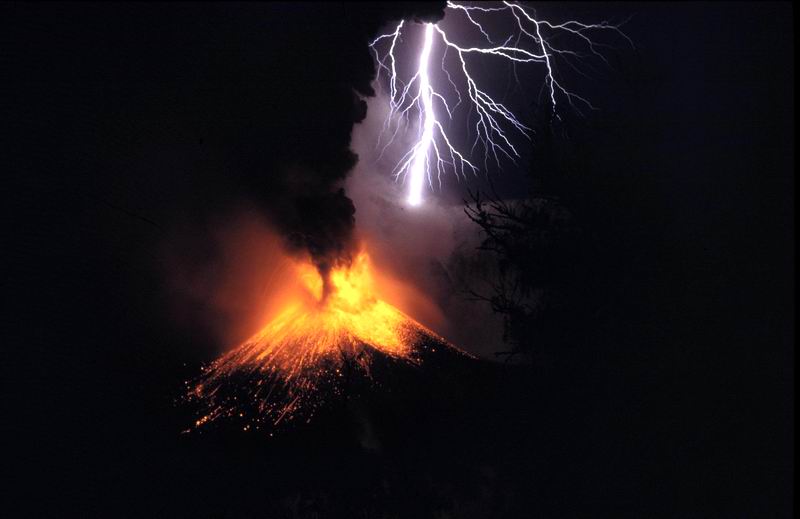
Mount Rinjani Eruption
Lombok, Indonesia
1994
Perhaps a goal Mormon's use of this theme was an attempt to unify the message of his life's work of abridging the Nephite record. The writings of Nephi show surprising literary sophistication in the opening pages of the Book of Mormon by his repeated use of word images and symbolism (probably a post unto itself).  For example, Nephi used the very same terms to describe 'the great and spacious building' of Lehi's dream (1 Nephi 12:4-5; 2 Nephi 26:3), 'the great and abominable church'  (1 Nephi 13:4-6; 1 Nephi 14:15-17and the 'great and terrible tempest' that threatened Nephi's ship while sailing to the Promised Land (1 Nephi 18:13). Nephi tagged these events and ideas with the word great or the phrase great and terrible. Nephi subsequently linked them to things such as the pride of the world, the church of the devil or personal apostasy.  Finally to complete the message, he links this unrighteousness with the eventual outpouring of the wrath of God in great and terrible ways.  It seems that Mormon took notice.

I think it no small coincidence that the pride of the people was the proximate cause of their destruction at the time of Christ's death (3 Nephi 6:14-16).  After many warnings and opportunities to repent and return to the Lord, his wrath was unleashed in great and terrible ways--just as Nephi and Samuel had foretold (here for an awesome article that explains this event geologically).  Mormon was undoubtedly reiterating the prophecies of earlier prophets that had foreseen this great and terrible dayNo doubt, he also used similar words as Samuel (Helaman 14:20-27) and Nephi (see 1 Nephi 12:4-5, 2 Nephi 26:3), who had seen it before it occurred.

Mormon may have also been tying into Hebraic ideas of the attributes of God. Today we find it a bit ironic to find 'great and terrible'  as terms associated with God (here for my post on The Fierceness of God).  Daniel prayed to "great and dreadful God" (Daniel 9:4) and David praised God's "great and terrible name" (a name which was simultaneously holy; Psalms 99:3).   Perhaps these were fitting for a God who fought their battles, destroyed their enemies and poured out his wrath on the unrighteous. For those that experienced that fateful day in 3 Nephi 8, few would disagree with Daniel or David.

Mormon's "great and terrible'  leitmotif therefore represents God's unrestrained wrath on those that have hearts hardened by pride and an unconquerable spirit that refuses to believe, and never understands and never bothers to repent or come to Christ. Though the day could be viewed as great in goodness because of the ministry of the Savior to the survivors, it was mostly a very bad day that was great in terribleness. What made it greatly terrible was the hardened hearts of the people that wouldn't believe and could not be converted. They simply never repented and ran out of time.

I think that if Wagner or Williams were asked to score Mormon's leitmotif it would be loud, dark, and somewhat chaotic . . . not the kind of music I prefer at all.


Sunday, September 30, 2012

Chiasmus in 3 Nephi 10

I'm continually impressed with the literary sophistication of the Book of Mormon--yet another testimony of it's veracity for me.  Much has been written about Book of Mormon examples of chiasmus, a rhetorical arrangement of concepts that was particularly common in ancient Hebrew writings. Chiastic form is common in the Old Testament, particularly when read in Hebrew. This rhetorical tool was extensively used a an aide-memoire in times when you couldn't easily jot down important things in a notebook (or smart phone).


An instance of chiasmus which I've not seen pointed out before sprang from the page as I read the words the Savior spoke to the Nephites and Lamanites that survived the 'great and terrible' day of his death (3 Nephi 10:4-6).

In this case, the chiastic structure is as follows:
a
  b
    c
    c
  b

  b
a
    c
  b
a'
    c'

a = fallen people
a’ = people spared by the Lord
b = house of Israel
c = hen gathering her chickens
c’ = hen gathering her chickens, if they repent and return


Here is the exact text of 3 Nephi 10:4-6 in the chiastic structure. 

a) O ye people of these great cities which have fallen,
b) who are descendants of Jacob, yea, who are of the house of Israel,
c) how oft have I gathered you as a hen gathereth her chickens under her wings, and have nourished you.
c) And again, how oft would I have gathered you as a hen gathereth her chickens under her wings, yea,
b) O ye people of the house of Israel,
a) who have fallen; yea,

b) O ye people of the house of Israel, ye that dwell at Jerusalem,
a) as ye that have fallen; yea,
c) how oft would I have gathered you as a hen gathereth her chickens, and ye would not.
b) O ye house of Israel
a’) whom I have spared,
c’) how oft will I gather you as a hen gathereth her chickens under her wings, if ye will repent and return unto me with full purpose of heart.

It is hard for me to read this and not 'glory in the Lord' even unto 'boasting in my God' and his restored gospel. Yet all these evidences seem to fall well short of persuading everyone.  

I saw a recent blog and article about Brandon Flowers, lead singer of The Killers, as he shared his faith on a Norwegian talk show. His host's intent was initially veiled--until they blind-sided Brandon by bringing out Richard Dawkins, one of the most vocal atheists of popular culture. In his personal attack on Flowers (and Mormonism in general), Dawkins dismissed the Book of Mormon as "an obvious fake" because it was "a 19th century book written in 16th century English".  Mr. Dawkins made a big deal about his conclusions after he "read" the Book of Mormon, but then quietly admitted that he had not read it all. He almost certainly didn't apply Moroni's formula to know of its truthfulness, since this falls outside of the paradigm of his science (it seems his blind devotion to his science is as strong as that which he criticizes in Brandon's faith). The nuances of ancient Hebrew literary tools being "faked" by an uneducated Vermont farm-boy will never persuade Mr. Dawkins that he may have failed to consider all the evidence. He has already decided.  

I've seen the scientific method fail many times during my medical research years, primarily because the investigator draws their conclusion prior to considering all the evidence, or because they allow their bias to influence their interpretation of the results.  The conclusion is written before the data have been fully vetted or analyzed; frequently the interpretation is out of context. It is critical to point out in these cases that it is not the scientific method that has failed but rather the investigator that has failed. 

This interview demonstrated a group of people that just couldn't understand the testimony of Brandon Flowers--largely because of their unbelief a priori. Mormon taught that in such cases, the quest for understanding is over before it starts:

"Because of their unbelief, they could not understand the word of God; and their hearts were hardened." Mosiah 26:3


Wednesday, September 26, 2012

The Fierceness of God


Ceiling of Sistine Chapel, by Michelangelo
fresco, 1508-1512
I have the tendency to think of God in terms of his great love.*  However, it's hard to spend any time reading the scriptures and ignore the fierceness of his anger and wrath. This is particularly true of the Old Testament, but also of the Book of Mormon.  I encountered this recently in reviewing the message of Samuel in the Book of Helaman.  After warning them that ‘heavy destruction’ awaited the unrepentant (apparently ordinary destruction was not enough), the Lord said:

Therefore, thus saith the Lord: Because of the hardness of the hearts of the people of the Nephites, except they repent I will take away my word from them, and I will withdraw my Spirit from them, and I will suffer them no longer, and I will turn the hearts of their brethren against them.
And four hundred years shall not pass away before I will cause that they shall be smitten; yea, I will visit them with the sword and with famine and with pestilence.
Yea, I will visit them in my fierce anger, and there shall be those of the fourth generation who shall live, of your enemies, to behold your utter destruction; and this shall surely come except ye repent, saith the Lord; and those of the fourth generation shall visit your destruction. (Alma 13:8-10)
It doesn't end there.  Samuel warns of physical destructions and curses that make your toes curl. It’s pretty scary to think about, especially in light of our need for such regular repentance.  There can be no doubt that he "cannot look upon sin with the least degree of allowance." (Alma 45:6; D&C 1:31) Though some sins are bigger than others, they've all got to go.  This reality represents a big problem for all of us. 

But in our fear and trembling, we must ever remember that fierce anger is not God's only fierce attribute: 
But if ye will repent and return unto the Lord your God I will turn away mine anger, saith the Lord; yea, thus saith the Lord, blessed are they who will repent and turn unto me, but wo unto him that repenteth not. (Helaman 13:11)
Though his anger is indeed fierce, his love (and mercy) is fiercer.  His willingness to literally forgive and forget is far greater than his capacity for wrath.  Think about how much greater effort it requires for us to extend mercy and forgiveness than to be angry. 

My initial tendency is to characterize this as selective amnesia.  But in reality it has nothing to do with amnesia since it is contingent on repentance.  The application of the atonement in the process of repentance literally takes the sin away.  It leaves us not only 'not guilty' but also 'innocent'. The true fierceness of the love of God is manifest in his willingness to sacrifice his only son as the lynch-pin of his grand plan of salvation. Yet in this wonderful news lies the somber warning: "wo unto him that repenteth not". In other words, don't get him angry.

In the end, hopefully it is okay to identify more with his love and mercy than with his wrath--so long as we take the opportunity to repent. After all, when it comes to ourselves,** we are counting on a God that is more loving and merciful than just.  

__________________

* Based on my recent reading of the 109 th Psalm, David must have related well to God's angry side  (here).
** For other people, I find that there's a tendency for us to want a God that is more about justice than mercy (as demonstrated in Psalms 109)--it's the ultimate double-standard. 


Monday, September 24, 2012

An Unconquerable Spirit


un·con·quer·a·ble
/ˌənˈkäNGk(ə)rəbəl/
Adjective:
(esp. of a place, people, or emotion) Not conquerable: "an unconquerable pride".
Synonyms:
invincible - insuperable - inexpugnable - insurmountable
____________________________________________

It's a word that generally evokes the most noble human qualities.  It occurs twice in the Book of Mormon.  Yet in both instances, it is used in a very negative context. The first is speaking of unconquerable spirit of Jacob the Zoramite, who was determined to destroy Moroni and the Nephite people (Alma 52:33).  The second is used by Giddianhi, the robber, to describe the bloodlust of his men who were also determined to annihilate the Nephites (3 Nephi 3:3-4). Though he describes their unconquerable spirit, there can be no doubt that this attribute was not something to be desired. In both examples, these men's hearts were so hardened by iniquity that they could not be touched by the Spirit. 

Today in Priesthood we were reading Dallin H. Oaks talk from April 2012 General Conference (here). He emphasized our need to "offer a sacrifice to [Him] of a broken heart and a contrite spirit" (3 Nephi 9:20). 

con·trite/kənˈtrīt/
Adjective:
Feeling or expressing remorse or penitence; affected by guilt.
Synonyms:
repentant - penitent - remorseful - regretful
____________________________________________

The hardened heart and unconquerable spirit of Jacob and the Gadianton robbers stands at the opposite end of the spectrum as the contrite spirit.  Consider the Savior in Gethsemane:

"Father, if thou be willing, remove this cup from me: nevertheless not my will, but thine, be done." (Luke 22:42)

His spirit was submissive and humble. He sacrificed and surrendered his will to God before he sacrificed himself for us.  The price of our redemption is no less. We must break the hard shell around our heart to allow the Spirit to penetrate it. We must wrestle with our own spirit to make it penitent and humble. Ultimately we must be willing to surrender our own will to that of our Father in Heaven to the atonement will make us whole.

Having an unconquerable spirit has positive connotations in contemporary usage, but the scriptures would suggest it’s much better to be contrite.

Sunday, August 19, 2012

Stripling Armies


My recent visit to the American invasion beaches of Normandy was unbelievably moving.  I'd recently finished Stephen Ambrose's best-seller D-Day to try and be ready for the experience. Despite almost 600 pages of minute by minute detail about the invasion, I wasn't remotely prepared. Our guide was simply fantastic and I can't imagine trying to do this without someone like him (Eric Le Deux-Turnbull) to put it into perspective (more on this another day).


A haunting picture of SS-Panzergrenadiers Sepp Bund, Klaus Schuh and Günther Hamel of Regiment 25  (12 SS-Panzerdivision “Hitlerjugend”) on June 12, 1944 in the orchard of the Abbaye d'Ardenne near Caen, Normandy. They had just been awarded the Iron Cross 2nd Class for destruction of  a British tank using only their MG42 on June 9, 1944. Only Hamel survived the War. (Sources: i & ii).


While in France, I was also doing some reading the closing chapters of Alma in anticipation of my Sunday School lesson on Helaman's Army. This morning at 4:00 AM (still on French time . . . ) I was struck with the contrasts between two stripling armies.

In June 1943, Adolf Hitler exulted with the formation of the 12th SS-Panzer Division Hilterjugende. By the fall of 1943, training of 16,000 recruits from the Hitler Youth movement was complete. Many of the recruits were so young that they were issued sweets rather than tobacco and alcohol as part of their regular rations. These striplings had grown up in the propaganda programs of Nazi Germany and were fanatically committed to the cause. From their mother's knees they were taught to trust their Fuhrer, and were prepared to die for the Fatherland. The division had been equipped with the finest weaponry that Nazi Germany had to offer and had been extensively trained with innovative techniques. The Hitlerjugende was led by officers and NCO's that had proven themselves on the eastern front; it enjoyed a camaraderie and morale that was unusually strong.  Hitler moved 12th SS-Panzer Division Hilterjugende to Caen, Normandy in March 1944 to help defend the European continent from the coming Allied Invasion.

In June of 1944, the 12th SS-Panzer Division Hilterjugende played a critical role in the Battle of Normandy.  They faced the Canadians and British after they landed on the beaches at Juno and Gold and then moved inland to take the rail and road hubs at Caen. Hitler's stripling division offered up fanatical resistance and a fight to the death mentality.  They were without doubt the most effective German fighting force in France.  Unfortunately, their war crimes against unarmed British and Canadian POWs is well-documented as well.  Good soldiers are not always good people.

On the other hand was Helaman's army of two thousand and sixty young men. Their Ammonite parents were willing to sacrifice their lives instead of spilling the blood of their enemies; the sons made a seemingly polar opposite covenant to take up arms and sacrifice their lives in the defense of their country.

And they were all young men, and they were exceedingly valiant for courage, and also for strength and activity; but behold, this was not all—they were men who were true at all times in whatsoever thing they were entrusted.              Alma 53:20

Now they had never fought, yet they did not fear death; and they did think more upon the liberty of their fathers than they did upon their lives; yea, they had been taught by their mothers, that if they did not doubt, God would deliver them. And they rehearsed unto me the words of their mothers, saying: We do not doubt our mothers knew it.        Alma 56:47-48

And as the remainder of our army were about to give way before the Lamanites, behold, those two thousand and sixty were firm and undaunted. Yea, and they did obey and observe to perform every word of command with exactness; yea, and even according to their faith it was done unto them; and I did remember the words which they said unto me that their mothers had taught them.      Alma 57:20-21 

Both armies were very young and, on the surface, hardly intimidating as a fighting force.  Yet both armies were committed, firm and fearless; they meted out death and destruction to their enemies with incredible effectiveness. Both had been taught to trust their leader and to obey with exactness and without hesitation.

The ultimate difference was who they chose to follow.  The stripling Hilterjugende followed Adolf Hitler, one of the most evil men the world has ever known.  They were committed to the principles of Nazism, which called for the conquest of it's neighbors and the utter destruction of Jew, Poles, Russians and others deemed racially inferior. By the end of July 1944, their ranks were decimated and numbered just over 2000. In contrast, the stripling Ammonites selected Helaman, the prophet of God, to be their General. They were committed to God and the principles of liberty for all men. They held firm not for several weeks, but for many months and in a variety of trials and hardships that included hard-fought battles, isolation and near starvation. Because of "their exceeding faith in what they were taught to believe", not one soul was lost on the field of battle.

But behold, they have received many wounds; nevertheless they stand fast in that liberty wherewith God has made them free; and they are strict to remember the Lord their God from day to day; yea, they do observe to keep his statues, and his judgments, and his commandments continually; and their faith is strong in the prophecies concerning that which is to come.    Alma 58:40

We like to feel assured that we are not so vulnerable to be led astray as were the Germans under Hitler’s National Socialist German Worker’s Party. But Hitler, like so many of the forces that threaten our souls, was a master of misinformation, propaganda and praying on the weaknesses of others when they were most vulnerable. Furthermore, he was content to make his gains by degrees.   The only way we can be confident in our ability to stand as firm as Helaman’s army is to be uncompromising in our commitment to God and follow his commandments with exactness. This is the stuff that ‘exceeding faith’ is made of, and the stuff that makes you invincible to your foes, no matter the odds. 



Tuesday, August 7, 2012

Rameumpti


For the Zoramites, the Rameuptom was all about indulging their pride. Yet everything was tidily packaged into something much more socially acceptable: worship. It is SO much easier to rationalize when couched in these terms. 


While teaching Sunday School recently, we spent a few minutes talking about the Rameumptom. Paul Riddle leaned over to Tate and indiscreetly pointed out that my Rameumptom was my new bike. It was pretty funny, and spot on. All I could say was Touche´.[1]

It's sobering to realize the degree to which we become experts in justifying the Rameumpti in our lives.  In this case, words like  fitness, performance, craftsmanship, passion all worked very well.[2] I guess there are some Zoramite tendencies (aka pride) in me that I need to still work on. Even more remarkable is my ability to instantly recognize the Rameumpti of others, even while perched atop one of my own that is so easily justifiable in my own mind. 

This is going to take some time . . . 


[1] In this case 3-4 times a week for at least and hour instead of a few moments on Sunday.
[2] I could go on at length about why I NEEDED the new French road bike with Italian components and tubular wheels.