Pages

Showing posts with label judgment. Show all posts

Monday, November 26, 2012

Machiavelli & Moroni: Happy in Hell?


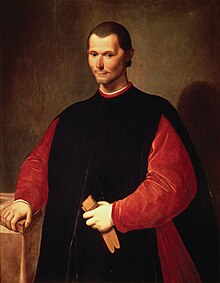
Portrait of Niccolò Machiavelli by Santi di Tito

Niccolò Machiavelli (1489-1527) was an influential politician and writer from Florence at the peak of the Italian Renaissance.  His work The Prince is so notoriously self-serving and unscrupulous, that it spawned the whole concept of Machiavellian ethics. Not surprisingly, he didn't exactly have the reputation of a pious saint. 

I recently read an account of "Machiavelli's dream" which reminded me of a similar passage written by Moroni.  Failing in health,  Niccolò's doctors could do nothing more for him and encouraged him to make peace with God. Shortly before his death, while surrounded by his friends, he recounted the details of a dream he had.  Maurizio Virol's biography of Machiavelli (Niccolò's Smile) describes his dream thus:

In his dream, he had seen a band of poorly dressed men, ragged and miserable in appearance. He asked them who they were. They replied, "We are the saintly and the blessed; we are on our way to Heaven." Then he saw a crowd of solemnly attired men, noble and grave in appearance, speaking seriously of important political matters. In their midst he recognized the great philosophers and historians of antiquity who had written fundamental works on politics and the state, such as Plato, Plutarch, and Tacitus. Again, he asked them who they were and where they were going. "We are the damned of Hell" was their answer. After telling his friends of his dream, Machiavelli remarked that he would be far happier in Hell, where he could discuss politics with the great men of the ancient world, than in Heaven, where he would languish in boredom among the blessed and the saintly. 

Machiavelli was also credited with this brutally honest admission:

I desire to go to Hell, not to Heaven. In Hell I shall enjoy the company of popes, kings and princes, but in Heaven are only beggars, monks, hermits and apostles. 

It would seem that Moroni foretold such sentiments 1100 years earlier. And, like Niccolò, was brutally honest about it:

Behold, I say unto you that ye would be more miserable to dwell with a holy and just God, under a consciousness of your filthiness before him, than ye would to dwell with the damned souls in hell. (Mormon 9:4)

Intuitively, one thinks they would obviously be happy in heaven and miserable in hell. Were we asked to let our wishes be known, everyone but the most Machiavellian among us would desire heaven.  Yet, sometimes people's actions speak louder than their wishful thinking. It's somewhat sobering to ask yourself where you'd be happier. If you were the fly on your life's wall . . . what would the evidence say?

I think that on judgment day there will be no surprises. We'll pretty much judge ourselves. Either we'll be thrilled to be in the presence of the Lord (D&C 121:45), or we’ll be dying to get to hell.


Sunday, November 18, 2012

Solzhenitsyn & Mormon: Parallel Perspectives

Aleksandr Solzhenitsyn (1918-2008)
Taken while a prisoner in a Kazakhstan Gulag

Aleksandr Solzhenitsyn won the Nobel Prize for literature in 1970 (One Day in the Life of Ivan Denisovich and The Gulag Archipelago).   A former Red Army captain, he was sentenced to eight years in a labor camp in 1945 for making derogatory comments about Joseph Stalin in a private letter to a friend. After being interrogated and tortured at Lubyanka prison in Moscow, he was sent to a Gulag in Kazakhstan to work and suffer. 

After the death of Stalin in 1953, Nikita Khrushchev assumed power. He ordered the release and exoneration of Solzhenitsyn in 1953, whereupon Solzhenitsyn secretly began documenting the horrors of the Stalinist regime and Gulag system. After the publication of One Day in the Life of Ivan Denisovich in 1962, Khrushchev used this popular book to exploit public sympathy in his attempts to purge the stains of Stalinism from the USSR.

Solzhenitsyn became instantly famous. His ordeals had taken him through a broad spectrum of the stations of life: impoverished peasant, university student, Red Army captain, political prisoner, secretive dissident and national celebrity.  Though he lived life both as victimizer and as victim, in the end, he found himself embracing the principles of liberty and Christianity.  It is another great story affirming the ability of men to rise above the wreckage by finding peace through Christ.

In reading Solzhenitsyn's story, I found a fascinating quote that harmonized with my current reading in the Book of Mormon:

Over a half century ago, while I was still a child, I recall hearing a number of old people offer the following explanation for the great disasters that had befallen Russia: "Men have forgotten God; that's why all this has happened." Since then I have spent well-nigh 50 years working on the history of our revolution; in the process I have read hundreds of books, collected hundreds of personal testimonies, and have already contributed eight volumes of my own toward the effort of clearing away the rubble left by that upheaval. But if I were asked today to formulate as concisely as possible the main cause of the ruinous revolution that swallowed up some 60 million of our people, I could not put it more accurately than to repeat: "Men have forgotten God; that's why all this has happened." *

Examples of people forgetting God and suffering the consequences of godlessness and unrestrained evil are so numerous that you can’t begin to list them all. But Solzhenitsyn's comment reminds me of Mormon’s powerful eye-witness account of a great people that met a similar fate.

And my soul was rent with anguish, because of the slain of my people, and I cried:  O ye fair ones, how could ye have departed from the ways of the Lord! O ye fair ones, how could have rejected that Jesus, who stood with open arms to receive you! Behold, if ye had not done this, ye would not have fallen. But behold, ye are fallen, and I mourn your loss. (Mormon 6:16-18)

Mormon's account of the final struggles and destruction of the Nephite people is almost overpowering in its sadness (see Mormon 2:11-15).  In some ways it surpassed the suffering seen in Solzhenitsyn's day, since it resulted in the disappearance of the Nephite civilization. In both cases, what makes the stories so sad is that the destruction was so needless. To turn from God is to trust in men; left to their own devices, men can do great evil.

In an ironic footnote, the need for men to root out their inner evil was emphasized by an unlikely messenger that played a pivotal role in Solzhenitsyn's life: Nikita Khrushchev. In a speech defending One Day in the Life of Ivan Denisovich to the Politburo, Khrushchev (of all people) warned of the potential we all have to harbor great evil within us:

"There's a Stalinist in each of you; there's even a Stalinist in me. We must root out this evil." **

Unlike Solzhenitsyn,*** Khrushchev never came to know that it is impossible to fully root out our inner evil without the atonement of Jesus Christ. Today it seems that history is doomed to repeat itself as men rush to forget God. As they turn away from the light of his gospel, they turn to darkness. Unfortunately, this darkness is the perfect environment for the Stalinist within us to awaken and flourish.
________

* Edward E. Ericson, Jr., "Solzhenitsyn – Voice from the Gulag," Eternity, October 1985, pp. 23–4
** Peter Benno, "The Political Aspect", in Max Hayward and Edward L. Crowley, eds., Soviet Literature in the 1960s (London, 1965), p. 191
*** When asked if Russia had simply replaced the evils of socialism with the evils of capitalism, Solzhenitsyn said: "In different places over the years I have had to prove that socialism, which to many western thinkers is a sort of kingdom of justice, was in fact full of coercion, of bureaucratic greed and corruption and avarice, and consistent within itself that socialism cannot be implemented without the aid of coercion. Communist propaganda would sometimes include statements such as "we include almost all the commandments of the Gospel in our ideology". The difference is that the Gospel asks all this to be achieved through love, through self-limitation, but socialism only uses coercion. This is one point. Untouched by the breath of God, unrestricted by human conscience, both capitalism and socialism are repulsive." (Joseph Pearce. "An Interview with Alexander Solzhenitsyn." St. Austin Review 2 no. 2 [February, 2003])

Wednesday, October 3, 2012

Mormon's 'Great and Terrible' Leitmotif in 3 Nephi 8

Leitmotif associated with Siegfried
from Richard Wagner's opera Siegfried - The Ring of the Nibelung
The concept of a leitmotif is a musical or literary theme that becomes associated with a particular person, place or  idea in a larger work.  Wagner is one of the earliest classical composers that used this.  Perhaps the best contemporary examples are John Williams' use of leitmotif in Star Wars (here for a great example).

The Book of Mormon holds many examples of literary leitmotif. In the case of 3 Nephi 8, Mormon uses 'great and terrible' (or sometimes these words individually) as a leitmotif throughout the chapter:
  • great doubtings and disputations (verse 4)
  • great storm (verse 5)
  • great and terrible tempest (verse 6)
  • terrible thunder (verse 6)
  • great and terrible destruction in the land southward (verse 11)
  • more great and terrible destruction in the land northward (verse 12)
  • exceedingly great quaking of the whole earth (verse 12)
  • great mourning and howling and weeping among all the people (verse 23)
  • great were the groanings of the people (verse 23)
  • darkness and the great destruction which had come upon them (verse 23)
  • 'O that we had repented before this great and terrible day' (verse 24)

Mount Rinjani Eruption
Lombok, Indonesia
1994
Perhaps a goal Mormon's use of this theme was an attempt to unify the message of his life's work of abridging the Nephite record. The writings of Nephi show surprising literary sophistication in the opening pages of the Book of Mormon by his repeated use of word images and symbolism (probably a post unto itself).  For example, Nephi used the very same terms to describe 'the great and spacious building' of Lehi's dream (1 Nephi 12:4-5; 2 Nephi 26:3), 'the great and abominable church'  (1 Nephi 13:4-6; 1 Nephi 14:15-17and the 'great and terrible tempest' that threatened Nephi's ship while sailing to the Promised Land (1 Nephi 18:13). Nephi tagged these events and ideas with the word great or the phrase great and terrible. Nephi subsequently linked them to things such as the pride of the world, the church of the devil or personal apostasy.  Finally to complete the message, he links this unrighteousness with the eventual outpouring of the wrath of God in great and terrible ways.  It seems that Mormon took notice.

I think it no small coincidence that the pride of the people was the proximate cause of their destruction at the time of Christ's death (3 Nephi 6:14-16).  After many warnings and opportunities to repent and return to the Lord, his wrath was unleashed in great and terrible ways--just as Nephi and Samuel had foretold (here for an awesome article that explains this event geologically).  Mormon was undoubtedly reiterating the prophecies of earlier prophets that had foreseen this great and terrible dayNo doubt, he also used similar words as Samuel (Helaman 14:20-27) and Nephi (see 1 Nephi 12:4-5, 2 Nephi 26:3), who had seen it before it occurred.

Mormon may have also been tying into Hebraic ideas of the attributes of God. Today we find it a bit ironic to find 'great and terrible'  as terms associated with God (here for my post on The Fierceness of God).  Daniel prayed to "great and dreadful God" (Daniel 9:4) and David praised God's "great and terrible name" (a name which was simultaneously holy; Psalms 99:3).   Perhaps these were fitting for a God who fought their battles, destroyed their enemies and poured out his wrath on the unrighteous. For those that experienced that fateful day in 3 Nephi 8, few would disagree with Daniel or David.

Mormon's "great and terrible'  leitmotif therefore represents God's unrestrained wrath on those that have hearts hardened by pride and an unconquerable spirit that refuses to believe, and never understands and never bothers to repent or come to Christ. Though the day could be viewed as great in goodness because of the ministry of the Savior to the survivors, it was mostly a very bad day that was great in terribleness. What made it greatly terrible was the hardened hearts of the people that wouldn't believe and could not be converted. They simply never repented and ran out of time.

I think that if Wagner or Williams were asked to score Mormon's leitmotif it would be loud, dark, and somewhat chaotic . . . not the kind of music I prefer at all.