Pages

Showing posts with label confidence. Show all posts

Monday, July 1, 2013

First Win = Yellow

fighting off the charging peloton


Is this really happening?


Woo Hoo!


I hate that I still love watching the Tour de France given the last year of doping scandals.  I just can't help it.  It is such a great sport.  Stage 2 of the Tour was set in Corsica, and had some of the most beautiful scenery I've seen in a long time. It's finish was the stuff that fairy tales are made of. 

Jan Bakelants is a 26-year old Belgian that rides for RadioShack. I'd never even heard of him before. He had never won a professional bike race.  On stage 2 he broke away from the peloton with 7 or 8 other riders with about 8 km to go.They had a small lead of up to 30 seconds but were slowly being reeled back  in.  When the peloton came charging up and swallowed up the others he refused to quit.  Somehow he hung on stayed ahead of the raging peloton to win by 1 second.  Not only did he win the stage, but he took the yellow jersey.  The look of disbelief as he crossed the line is priceless. His yellow jersey picture is pure jubilation.

After the stage win, he was thronged by reporters wanting to capture his reaction.  I found it fascinating that he said when he looked back with 500 meters to go, he knew he would win. As I watched I was certain he would somehow be caught by Peter Sagan at the line and lose.  Thankfully he was right and I was wrong. 

Another relative nobody on the tour has his unbelievable moment of glory and reward for such a great effort. It reminds me of another racer that was also confident of victory.
As for me, my life has already been poured out as an offering to God. The time of my death is near. I have fought the good fight, I have finished the race, and I have remained faithful. And now the prize awaits me—the crown of righteousness, which the Lord, the righteous Judge, will give me on the day of his return. And the prize is not just for me but for all who eagerly look forward to his appearing. NLT 2 Timothy 4:6-8
Sometimes one big win is all you'll ever get in life. These big wins don't just happen. They happen to people that are willing to go for it in spite of all the adversity and negative odds against them.  

Once TDF starts, I find myself having weird dreams of me riding the Tour and occasionally winning a stage.  It's great stuff but just dreams.  I need to somehow focus more intently on the real race that Paul was racing and won.  He knew he would win before he reached he finish line. It's a race I can win, and the prize will be far more glorious.  Somehow, I think I'll probably keep dreaming about stage wins at the TDF.

Monday, November 26, 2012

Machiavelli & Moroni: Happy in Hell?


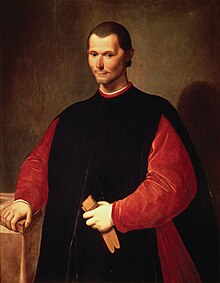
Portrait of Niccolò Machiavelli by Santi di Tito

Niccolò Machiavelli (1489-1527) was an influential politician and writer from Florence at the peak of the Italian Renaissance.  His work The Prince is so notoriously self-serving and unscrupulous, that it spawned the whole concept of Machiavellian ethics. Not surprisingly, he didn't exactly have the reputation of a pious saint. 

I recently read an account of "Machiavelli's dream" which reminded me of a similar passage written by Moroni.  Failing in health,  Niccolò's doctors could do nothing more for him and encouraged him to make peace with God. Shortly before his death, while surrounded by his friends, he recounted the details of a dream he had.  Maurizio Virol's biography of Machiavelli (Niccolò's Smile) describes his dream thus:

In his dream, he had seen a band of poorly dressed men, ragged and miserable in appearance. He asked them who they were. They replied, "We are the saintly and the blessed; we are on our way to Heaven." Then he saw a crowd of solemnly attired men, noble and grave in appearance, speaking seriously of important political matters. In their midst he recognized the great philosophers and historians of antiquity who had written fundamental works on politics and the state, such as Plato, Plutarch, and Tacitus. Again, he asked them who they were and where they were going. "We are the damned of Hell" was their answer. After telling his friends of his dream, Machiavelli remarked that he would be far happier in Hell, where he could discuss politics with the great men of the ancient world, than in Heaven, where he would languish in boredom among the blessed and the saintly. 

Machiavelli was also credited with this brutally honest admission:

I desire to go to Hell, not to Heaven. In Hell I shall enjoy the company of popes, kings and princes, but in Heaven are only beggars, monks, hermits and apostles. 

It would seem that Moroni foretold such sentiments 1100 years earlier. And, like Niccolò, was brutally honest about it:

Behold, I say unto you that ye would be more miserable to dwell with a holy and just God, under a consciousness of your filthiness before him, than ye would to dwell with the damned souls in hell. (Mormon 9:4)

Intuitively, one thinks they would obviously be happy in heaven and miserable in hell. Were we asked to let our wishes be known, everyone but the most Machiavellian among us would desire heaven.  Yet, sometimes people's actions speak louder than their wishful thinking. It's somewhat sobering to ask yourself where you'd be happier. If you were the fly on your life's wall . . . what would the evidence say?

I think that on judgment day there will be no surprises. We'll pretty much judge ourselves. Either we'll be thrilled to be in the presence of the Lord (D&C 121:45), or we’ll be dying to get to hell.


Wednesday, October 10, 2012

Invictus: To Tame the Unconquerable

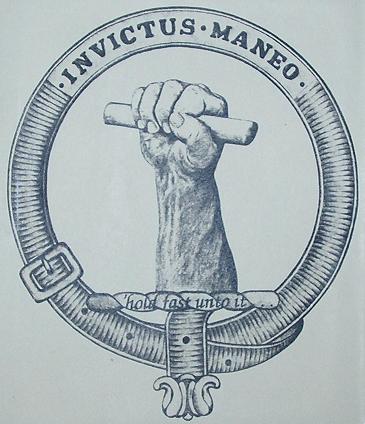
Armstrong Clan Motto: 'I Remain Unconquered'

My recent post (An Unconquerable Spirit) has me thinking of a poem that has ever inspired me. Invictus was penned in 1875 by the English poet William Ernest Henley.  As an adolescent Henley was afflicted with tuberculous osteomyelitis (tuberculosis of bone) in his lower extremities.  He was told that both his legs would need to be amputated below the knees to save his life. He agreed to amputation of the left leg at 12 but repeatedly refused the second amputation. He spent much of his early life hospitalized and chronically ill. Eventually with the assistance of Dr. Joseph Lister, the father of antiseptic surgery, Henley was able to recover and enjoy a vigorous life until a fall from a railway carriage induced a relapse of his tuberculosis and ultimately his death at 54.  

Though plagued by ill-health and disability from an early age, Henley was highly acclaimed and reasonably successful in his life. Henley's theology was that of an agnostic; he was much more interested in the humanist movement than in organized religion or Christianity. And, in an era were people looked to God for rescue, he maintained that the harnessing the power within was sufficient to tackle anything that life could throw at you. 

Invictus is a Latin term for unconquerable, unvanquished or undefeated. Henley's poem is a window into his own spirit of invictus that was shaped by his irrepressible determination and self-confidence. Without doubt, this is part of what gave Henley the willpower to overcome years of illness, despair, and misfortune.  Even a small measure of his spirit of invictus would serve us all very well. 

William Ernest Henley (1849-1903)

Invictus
William Ernest Henley

Out of the night that covers me,
Black as the Pit from pole to pole,
I thank whatever gods may be
For my unconquerable soul.

In the fell clutch of circumstance
I have not winced nor cried aloud.
Under the bludgeonings of chance
My head is bloody, but unbowed.

Beyond this place of wrath and tears
Looms but the Horror of the shade,
And yet the menace of the years
Finds, and shall find, me unafraid.

It matters not how strait the gate,
How charged with punishments the scroll,
I am the master of my fate:
I am the captain of my soul.
- - - -
There is a certain machismo and that comes from the 'never surrender and never back down' mentality that embodies Invictus. I suppose that in this regard Henley was generations ahead of his time--the era of self-help is firmly ensconced today. But the precosciousness of Henley's popular poem raised some eyebrows in the Christian communities of his time. Enter Orson F. Whitney. Born in Salt Lake City, he was a journalist, historian, poet, academic and politician. He also served as an apostle of the Church of Jesus Christ of Latter-day Saints. As a devout disciple of Jesus Christ, he took issue with the spirit of invictus that suggested that a 'do it yourself' mentality was all men really needed.  His poetic rebuttal,The Soul's Captain, is masterful. 
Orson F. Whitney (1855-1931)
The Soul's Captain
ORSON F. WHITNEY

Art thou in truth? Then what of Him
Who bought thee with His blood?
Who plunged into devouring seas
And snatched thee from the flood,

Who bore for all our fallen race
What none but Him could bear--
That God who died that man might live
And endless glory share.

Of what avail thy vaunted strength
Apart from His vast might?
Pray that His light may pierce the gloom
That thou mayest see aright.

Men are as bubbles on the wave,
As leaves upon the tree,
Thou, captain of thy soul! Forsooth,
Who gave that place to thee?

Free will is thine- free agency,
To wield for right or wrong;
But thou must answer unto Him
To whom all souls belong.

Bend to the dust that "head unbowed,"
Small part of life's great whole,
And see in Him and Him alone,
The captain of thy soul.

- - - -
There is no doubt that the spirit of invictus embodies a courage and determination that is valuable in taking on the world, and the challenges it will throw our way.  But to place all our hopes and dreams in self is risky. Most people are simply not prepared for disappointment and failure on the scale invoked by the consistency of our own failings. Though time teaches us to expect others to disappoint us, we never get over our ability to disappoint ourselves. To be so completely invested in the spirit of invictus is futile when we are--from the outset--so flawed. This is especially true when we have a loving Father in Heaven who is perfect (Matthew 5:48). He stands ready and waiting to bless us, comfort us and lighten our burdens as soon as we ask (Matthew 7:7-11). Taken to extremes, the spirit of invictus would persuade us not to ask.

The perspective of Elder Whitney is crucial in recognizing that there are some things we can't do for ourselves. On our own we are hopelessly flawed and simply can't change this without a Savior. Though Henley's spirit of invictus is laudable, to be healed we still must turn to Christ, tame that unconquerable soul and surrender our sword to Jesus Christ--the Captain of our soul.

Saturday, September 22, 2012

The Ugly Duchess (Part 2)


It's hard to look at The Ugly Duchess and not come away moved by her eyes.  They are completely out of keeping with everything else about her. While most folks in her shoes would be hiding behind their veil, she poses unashamedly. Those eyes shout out self-confidence and contentment; they speak of a certain inner beauty that is certainly not obvious at first glance. I, and many others, have made much of the Duchess' ugliness.  Yet the Duchess truly appears gruntled (it's a word we don't use enough). Perhaps not enough is made of her composure and confidence.  

What explains this? Maybe she's fabulously rich.  It's possible she's surrounded herself with people that have convinced her that she's the cat's meow (like the Emperor with no clothes). Wouldn't it be great if it was because she's truly comfortable in her own skin?

It seems that this kind of contentedness and self-confidence is a lifelong quest for most of us. This pursuit is ever complicated by the flaws we all have.  Ultimately, we're trying to gain this elusive goal not just in this life, but when we stand before God at the last day. Maybe that's why I find the scriptural references to confidence before God to be fascinating.  Nowhere is that confidence better demonstrated than in the final words of Enos:
And I soon go to the place of my rest, which is with my Redeemer; for I know that in him I shall rest. And I rejoice in the day when my mortal shall put on immortality, and shall stand before him; then shall I see his face with pleasure, and he will say unto me: Come unto me, ye blessed, there is a place prepared for you in the mansions of my Father.  (Enos 1:27)
The only thing that brings this kind of confidence is redemption through the atonement of Jesus Christ. It is a process that takes away the ugliness of sin, and makes us feel beautiful through and through. 
. . . then shall thy confidence wax strong in the presence of God . . .(D & C 121:45)